
When 'We’re a Family Here’ Is a Trust Problem

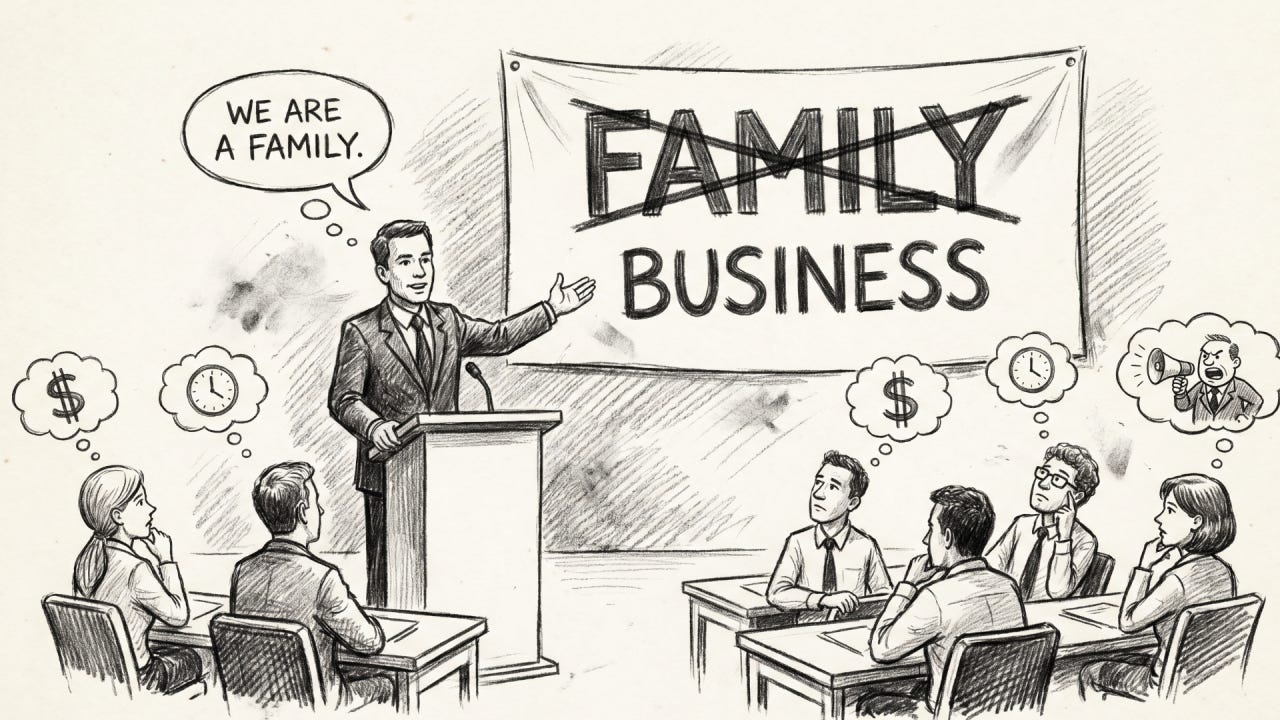
“We’re a family here …” How many times have you heard a CEO or president say this about their workforce? Is it sincere—or a shortcut to extract extra, unpaid effort? Or worse?
Calling a workplace “a family” isn’t harmless culture talk. It’s often a rhetorical shortcut used to purchase loyalty without earning it - and it routinely creates confusion about expectations, obligation, and accountability.
Here’s the problem: families are bound by blood, marriage, or lifelong commitment. Employment is a voluntary, compensated agreement. When leaders blur that line, they create a false moral obligation - implying people should sacrifice, endure poor treatment, or accept vague promises because “that’s what family does.”
This language also ignores reality: not everyone has a positive experience with family. For some, “family” signals dysfunction, coercion, or control. Using the term at work is a gamble with meaning - and the leader doesn’t get to decide what it means for the listener.
Even when well-intended, the analogy does damage in three ways:
It misrepresents the deal. If compensation is exchanged for work, that relationship is fundamentally transactional. This isn’t cynical - it’s clarity.
It distorts expectations. “Family” language quietly suggests unlimited commitment, loyalty without boundaries, and forgiveness without accountability.
It undermines growth and mobility. Families are largely static hierarchies, changing mainly when people die, are born, or marry/adopt into the family. Organizations should offer opportunity, merit-based advancement, and clear paths - not implied permanence.
The deeper issue is credibility. If a leader is willing to promote something so obviously untrue, why should anyone trust that leader on compensation, promotions, performance standards, or career opportunity?
This reflects the concept of demonstrated unreliability, something I learned in the Navy. When someone engages in negative behavior without sincere remorse and accountability, they’re highly likely to repeat it. Equal or worse behaviors follow because the pattern has been rewarded. That pattern is expensive: it drives cynicism, attrition, and the quiet disengagement that kills execution.
What to do instead
If you need people to take specific actions - on a project, in a risky role, or on a long-term initiative - earn it with value and clarity, not deception. This also applies to partners and customers.
Treat people with dignity. Don’t ask for “family-level” sacrifice that masks unmet promises and denied opportunities “for the good of the family.”
Provide context and expectations. Make the exchange explicit: what you need, why it matters, what success looks like, and how it benefits them (compensation, scope, visibility, advancement, skill development, mission impact).
Protect trust as an asset. Character is not slogans. It’s the consistency between what leaders say and what leaders do. Guard your reputation.
Correcting “we’re a family” language isn’t complicated—but it does take discipline. Define real obligations, set clear expectations, and treat people as adults and professionals. Even when it’s well-intentioned, stop using this euphemism. Know what matters to your audiences. Communicate with character to build a durable foundation for execution and prosperity.
For more detail on Chad’s communication work with leaders and professionals, see www.executivecommunicationadvisory.com.